
Does Pain Always Mean Damage? A Chiropractor in Bath Explains
Have you ever experienced back pain when bending forward, felt a twinge when lifting something, or been told that your spine is “worn out” after a scan?
If so, you might have wondered whether you're damaging your body every time you feel pain.
It's a common concern I hear from patients at Bath Chiropractic Clinic. Understandably, pain can make you cautious about moving, particularly when you've been told there's something wrong with your spine.
But there's an important distinction worth understanding: pain doesn't always mean damage, and the amount of pain you feel doesn't necessarily tell you how much damage there is.
I'm Charlie Fry, a chiropractor in Bath, and I'd like to explain what this means, why scan results don't always tell the whole story, and how understanding pain can help you feel more confident about moving again.
What is the difference between pain and damage?
Pain is a very real experience. It can affect your sleep, mood, work, exercise and everyday life. But pain isn't simply a direct measurement of what's happening in your tissues.
Your nervous system detects information from the body and processes it alongside other information, helping your brain assess whether something might require protection. This process is influenced by a range of factors, not just tissue damage.
An easy way to understand this is to think about a few familiar experiences.
Brain freeze: You can experience an intense headache after eating something cold quickly, even though you haven't caused the kind of tissue damage you might associate with that level of discomfort.
A paper cut: A tiny cut can be surprisingly painful because the area is sensitive and the body's protective response is switched on.
Lemon juice: Imagine squeezing lemon juice onto a paper cut. The same small injury can suddenly feel much more painful when another irritating stimulus is added.
These examples help illustrate that pain is influenced by context, sensitivity and how the nervous system responds. It isn't a simple one-to-one relationship between the amount of tissue damage and the amount of pain you feel.
This doesn't mean pain is imaginary or that injuries don't matter. Tissue damage can absolutely cause pain, particularly following an injury. The point is that pain and tissue damage are related, but they aren't the same thing.
Why can pain persist when an injury has healed?
Pain is particularly useful as a warning signal when an injury is new. If you sprain your ankle or strain your back, pain can encourage you to protect the area while the tissues recover.
However, pain doesn't always settle as soon as the initial injury has healed.
With longer-term pain, the nervous system can become more sensitive and protective. Activities that were once comfortable may start to feel painful, even when they aren't causing further harm. Sleep, stress, previous experiences, reduced activity and worries about movement can all influence how pain is experienced.
This doesn't mean the pain is all in your head. Longer-term pain is real, and it can be influenced by changes in how the body and nervous system process information. The factors involved differ from person to person.
For example, someone with recurring lower back pain might begin avoiding bending because they associate it with injury. Over time, they may become less confident, reduce their activity and find everyday movements increasingly difficult.
In some cases, gradually rebuilding confidence and capacity through appropriate movement and exercise can help. The aim isn't to ignore pain or push through everything, but to understand what's happening and find a sensible way forward.
Does a scan showing a arthritis mean something is wrong?
This is another important part of understanding pain.
Many people arrive at the clinic having been told they have a disc bulge, disc degeneration or arthritis. Hearing these terms can be worrying, particularly if they sound as though the spine is deteriorating or becoming fragile.
But these findings need to be interpreted in context.
A well-known 2015 systematic review by Brinjikji and colleagues examined spinal imaging in 3,110 people without back pain. The researchers found that disc degeneration was present in an estimated 37% of people aged 20, rising to 96% by age 80. Disc bulges were also common in people who had no symptoms. See further findings below!
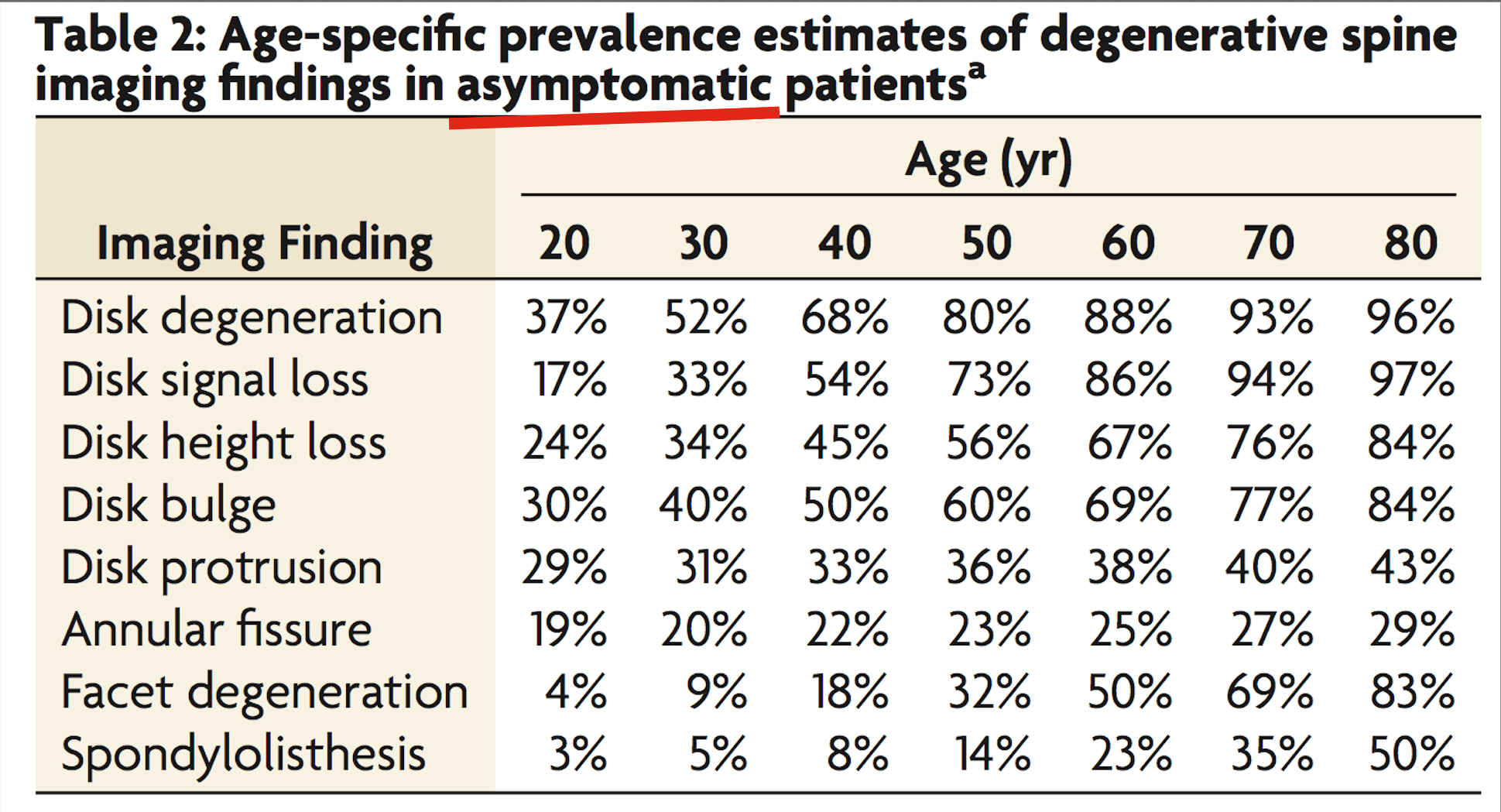
Source: Brinjikji et al. (2015), systematic review of spinal imaging in asymptomatic people. Figures are age-specific estimates not individual predictions.
What does this tell us?
It shows that changes seen on a scan don't automatically explain someone's pain. Some findings may be relevant, while others may simply reflect normal ageing and be unrelated to their symptoms.
A scan is one piece of the picture, not the whole story. Your symptoms, medical history, examination and how you're functioning all matter when deciding what a finding means for you.
If you've been told your spine is “worn out”, it doesn't automatically mean you're fragile, that movement is damaging you, or that you'll inevitably get worse.
So, should you ignore pain?
Absolutely not.
Pain is worth listening to, particularly when it's new, severe, persistent or changing. The key is understanding what it might mean rather than automatically assuming the worst.
If you're experiencing pain, it's sensible to get an appropriate assessment, especially if you're unsure what's causing it. A healthcare professional can help identify signs of injury or an underlying condition that needs specific investigation or treatment.
Seek urgent medical assessment if back pain is accompanied by new difficulty passing or controlling urine or bowel movements, numbness around the groin or saddle area, or new or progressive leg weakness. Significant trauma, fever or feeling seriously unwell alongside pain also warrants prompt medical advice.
For many common musculoskeletal problems, though, complete rest and avoiding movement indefinitely aren't usually the answer. Depending on the problem, staying active within your tolerance and gradually rebuilding strength and confidence can be an important part of recovery.
The goal is to find the right balance between respecting your symptoms and not letting fear unnecessarily restrict your life.
How can a Chiropractor help you understand pain?
At Bath Chiropractic Clinic, I take time to listen to each person's story and understand how their symptoms affect their everyday life.
Pain isn't experienced in isolation. Work, sport, sleep, stress, previous injuries and personal concerns can all be relevant. That's why I don't want to focus solely on the painful area or assume that the same approach will suit everyone.
Depending on your presentation and goals, your care may include:
Hands-on treatment to help manage symptoms and make movement more comfortable.
Exercise and rehabilitation to build strength, improve capacity and gradually return to activities that matter to you.
Advice and education to help you understand your symptoms and feel more confident managing them.
Progress reviews to see how you're responding and adjust the approach where needed.
Treatment is guided by your individual assessment, preferences and response. If your symptoms suggest that further medical assessment is needed, I'll explain this and help you consider the appropriate next steps.
My aim isn't simply to help you feel better during an appointment. It's to help you understand your pain, build confidence in your body and work towards the things you want to get back to doing.
The takeaway: pain doesn't always mean damage
If there's one thing I'd like you to take away from this article, it's that feeling pain doesn't automatically mean you're causing damage, and a scan showing changes doesn't necessarily mean those changes are the cause of your symptoms.
Pain should always be taken seriously, but it doesn't have to mean your body is broken or that movement is something to fear.
With the right assessment, a better understanding of your symptoms and an appropriate plan, it's often possible to make progress towards feeling and moving better.
Looking for help with pain in Bath?
If back pain, neck pain, joint discomfort or a sports injury is affecting your everyday life, I'd be happy to help you understand your options.
At Bath Chiropractic Clinic, I offer personalised, evidence-informed musculoskeletal care, with time to listen, explain and work towards your goals.
You can find us at The Bath Practice, 26 Monmouth Street, Bath.
Written by Charlie Fry, MChiro
Bath Chiropractic Clinic | Feel better, move better.
References
Brinjikji W, et al. (2015). Systematic literature review of imaging features of spinal degeneration in asymptomatic populations. American Journal of Neuroradiology, 36(4), 811–816.
International Association for the Study of Pain. IASP terminology and definition of pain.
.